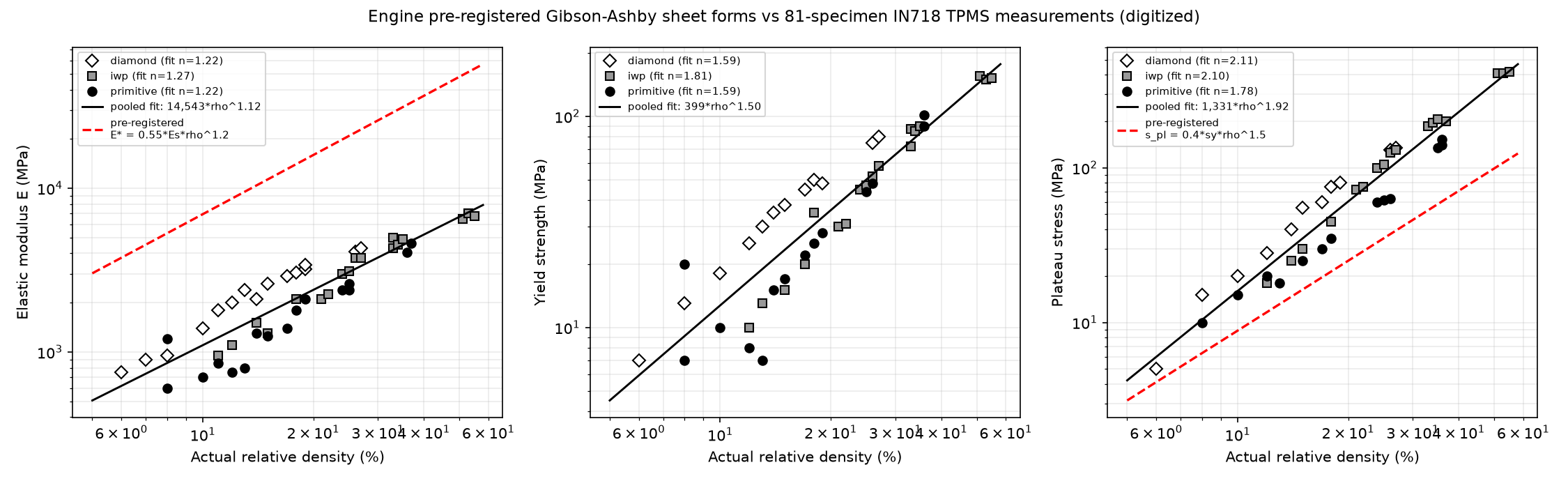
 — measured clouds per family, the
pre-registered curves, and the fitted power laws, all three properties.
— measured clouds per family, the
pre-registered curves, and the fitted power laws, all three properties.Run 2026-08-10 · calibration study (not blind — the forms were pre-registered in code before this comparison; the data is published literature) · files here: the digitized measurement clouds (JSON), the analysis script, the comparison figure.
The largest public measured lattice dataset we found: 81 printed IN718
sheet-TPMS compression specimens — {Diamond, I-WP, Primitive} × cell
{4, 6, 8 mm} × {3, 4, 6} cells × wall {200, 400, 600 µm} — with measured
elastic modulus, yield, plateau stress, and relative density per design.
Source: Materials 14(14):3962 (2021), CC-BY-4.0. The paper publishes
no raw table, so the property-vs-density clouds were digitized from its
figures (stated uncertainty ±1 density point, ±5–10% on values —
digitized_points.json, reproducible via compare_ga.py).
Our lattice generator writes its stiffness/strength predictions down before anything is printed, using deliberately uncalibrated handbook Gibson–Ashby forms — they exist to be wrong in a measurable direction:
| Claim | Measured (fitted) | Verdict |
|---|---|---|
| Modulus exponent 1.2 | 1.22 / 1.27 / 1.22 per family | Confirmed — the scaling form holds across all three TPMS types |
| Modulus constant | ~6.5–7× lower than predicted | Wrong, with a caveat: the source tests lack a machine-compliance correction, which systematically deflates absolute lattice moduli — so the correction is a bound, not a truth. The exponent survives that artifact; the constant awaits better data |
| Plateau exponent 1.5 | ~1.9–2.1 | Too shallow — real plateaus climb faster with density |
| Plateau constant | measured 2–3× higher than predicted | Conservative in the safe direction |
| One sheet-TPMS curve fits all | Families separate measurably (Diamond stiffest per density; I-WP strongest at high density) | Per-family constants beat a single curve |
Figure: — measured clouds per family, the
pre-registered curves, and the fitted power laws, all three properties.
The calibrated constants are documented (here and in our working notes) as calibration candidates. They were not silently swapped into the generator: pre-registration only means something if the numbers don't move quietly after contact with data. Adopting them is a deliberate, recorded change — and laboratory compression tests with proper compliance correction are the data that would justify it.
One alloy, one machine, as-built condition: these constants are IN718 / Concept Laser M2 specific. Transfer to other alloys is an assumption and is labeled as one wherever our reports use these forms.
Audit this receipt on GitHub → raw reports, data files, commit history