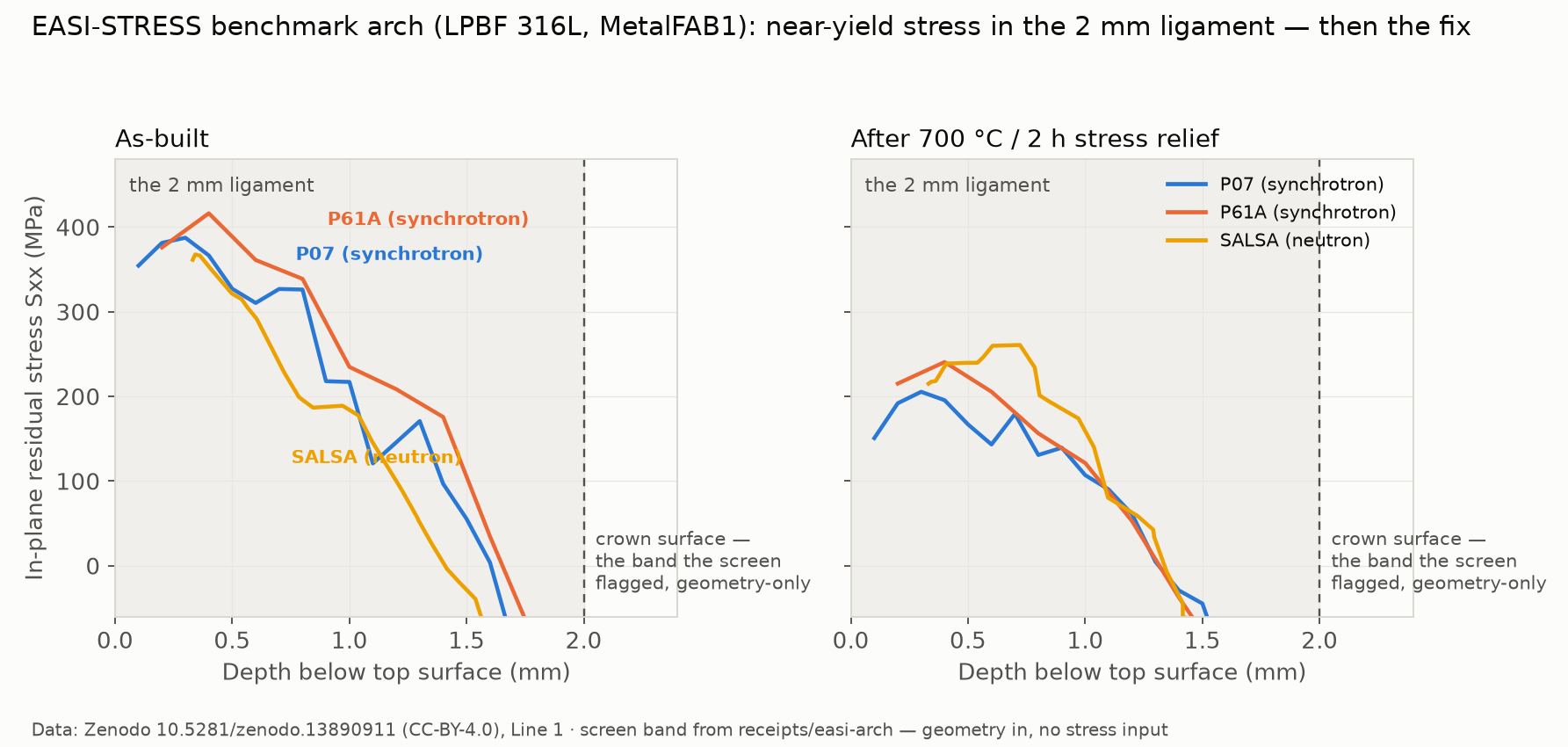
 — measured Sxx vs. depth, three
instruments, as-built beside heat-treated, with the screen's flagged
crown boundary marked.
— measured Sxx vs. depth, three
instruments, as-built beside heat-treated, with the screen's flagged
crown boundary marked.Run 2026-08-10, updated same day with exact geometry · NOT a blind run, and labeled so · files here: our reconstructed STL, the unedited report JSON, both CC-BY data workbooks, the stress-vs-depth figure.
The EU EASI-STRESS project's residual-stress benchmark: an LPBF 316L arch, 20 × 20 × 10 mm — a central 8 mm tunnel with vertical sides and a 4 mm-radius crown whose apex sits 2 mm below the top surface, leaving a 2 mm ligament. Built on two machines (MetalFAB1 and EOS M290), measured as-built and after 700 °C / 2 h stress relief by four diffraction instruments across three facilities: neutron diffraction at ILL (SALSA) and synchrotron X-ray diffraction at DESY (P07, P61A) and ESRF (ID15A). Inter-instrument agreement ~50 MPa; the source paper's own words: "near-yield level residual stresses."
Not blind: the measurement workbooks were opened before the screen ran (they were needed to establish the measurement-line coordinate system). The screen itself takes only geometry and has no stress input — but the honest claim class here is localization comparison, not blind prediction. The blind receipts are the two NIST bridges.
The labs measure from the top surface downward; their 0–2 mm measurement line is the ligament. The screen, from geometry alone:
overhang watch at z = 6.85–8.0 mm — the crown band where the
4 mm arc passes the 45° self-support angle on its way to horizontal —
directly beneath the ligament where all four instruments measured
peak in-plane stress: ~350–415 MPa as-built.thin_wall finds the ligament at 2.0 mm exactly — and correctly
does not flag it (it's above the process floor).Figure: — measured Sxx vs. depth, three
instruments, as-built beside heat-treated, with the screen's flagged
crown boundary marked.
Before the source paper was in hand, we reconstructed the arch from database nominals and guessed a flat-roofed opening. That wrong shape produced sharp 90° internal corners, which the screen flagged — and we initially matched that finding to the measured stress. The real crown is a smooth 4 mm radius: no corners exist, and on the exact geometry the screen reports zero severe concave edges. ~~The re-entrant corner finding~~ is withdrawn; the stress-localization claim rests on the overhang/downskin band alone, where it belonged. Lesson recorded: bracketing an unknown dimension cannot rescue a wrong shape family — get the drawing.
Localization, not magnitudes: nothing here claims 400 MPa was predicted. The claim is that the geometric screen pointed at the band where four independent instruments found the stress — and that when our own reconstruction was wrong, we said so in writing.
Audit this receipt on GitHub → raw reports, data files, commit history