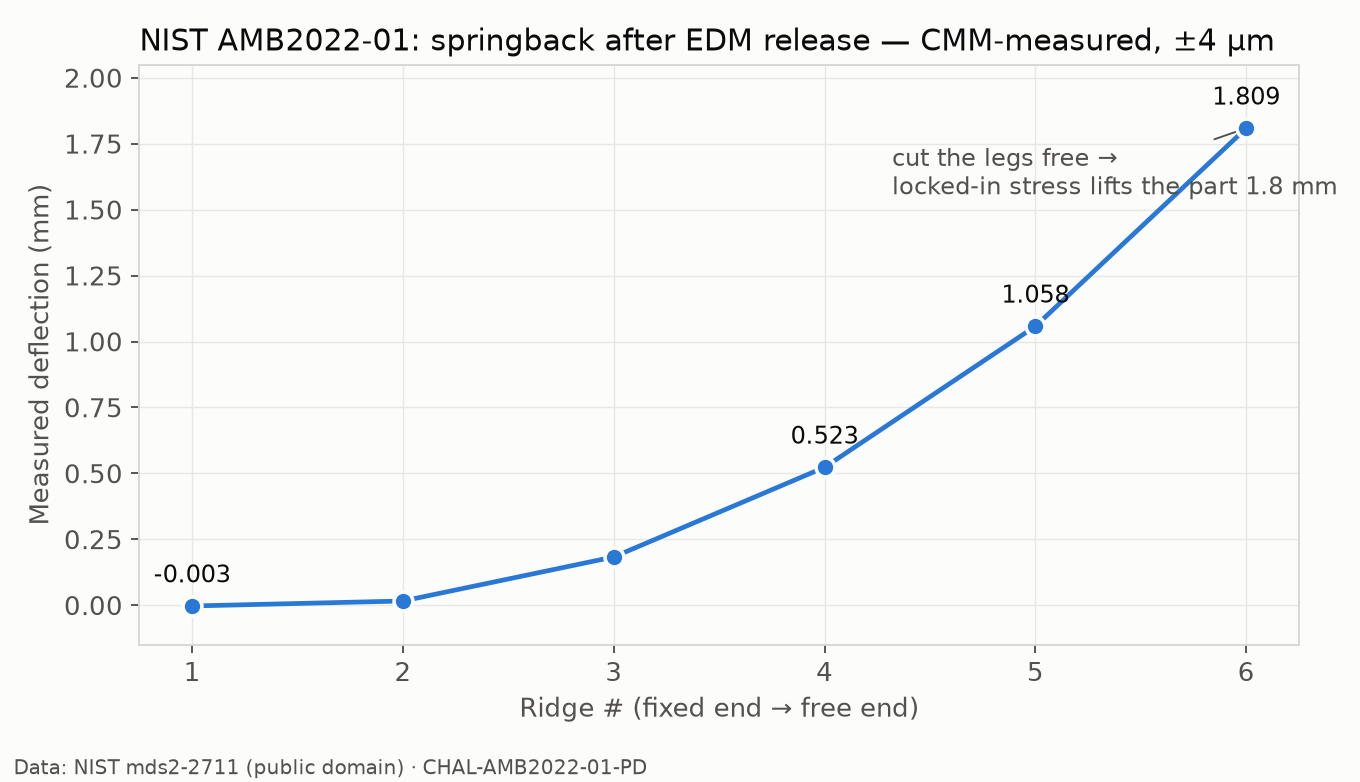
Run 2026-08-10 · blind protocol · files here: NIST's STL + its published sha256, the unedited blind report JSON, the measured-deflection table as machine-readable JSON, the springback figure.
The 2022 successor to the 2018 bridge: IN718, 75 × 5 × 12.5 mm, twelve 45°-overhang legs — with a twist. One leg (L10) is secretly hollow: 0.5 mm outer walls, single- and double-track-width internal walls, sealed at the top with powder inside forever. Built on NIST's AMMT testbed; ridge tops skim-ground; CMM-measured before and after all twelve legs were EDM-cut, so residual stress lifts the part.
mds2-2607 (doi 10.18434/mds2-2607) — STL + sha256 in
this folder, checksum verified against NIST's published hash.mds2-2711 (doi 10.18434/mds2-2711) — CMM ridge
deflections −0.003, 0.016, 0.183, 0.523, 1.058, 1.809 mm (ridges
1–6, expanded uncertainty ±0.004 mm, k=2), published by NIST as a PDF
table only; transcribed to JSON here
(AMB2022-01_measured_deflection.json). Plus a 2,248-point synchrotron
residual-strain field (CHESS).Geometry downloaded and sha256-verified; screen run at the closest
windows (IN718 → inconel, AMMT → eos_m290 envelope); raw report
committed before the measurement files were fetched — commit
c0ddce8, 2026-08-10 (see the README's provenance note). Disclosure,
stronger than usual: the reconnaissance that selected this target had
already surfaced NIST's headline numbers, so the operator was not
ignorant of them. The blindness claim attaches entirely to the
deterministic code and the auditable commit order.
| Blind screen | NIST's measurement / build fact | Verdict |
|---|---|---|
overhang pass — 0.39% of surface needs support at the 45° limit, risk faces at the span underside |
The part builds support-free by design, and did | Agrees at the process edge |
thin_wall flag — min sampled thickness 0.109 mm, p05 0.499 mm |
L10's internal walls are deliberately single/double track width (~0.1/0.2 mm); the outer walls are 0.5 mm by design | Both designed-in thin features found to the third decimal |
stress_concentrators watch — 338 mm of severe concave edges across the leg-junction band (z 1–12 mm) |
On EDM release the part lifts monotonically toward the free end: −0.003 → 1.809 mm | Localizes where the measured springback releases from |
| Build-time warp screens: pass | The build completed; deflection appears only after the cut | Agrees, boundary stated |
trapped_powder at the default 0.62 mm scan grid: "no enclosed cavities resolved at this pitch" |
L10 is a sealed, powder-filled cavity | A miss — honestly labeled by the tool itself (the sealing walls are thinner than the grid), see below |
The sealed cavity leaked through the default voxel screen because its 0.5 mm walls are thinner than the 0.62 mm scan grid — and the report's own language anticipated exactly this ("passages narrower than the grid are invisible here"). The tool's built-in refinement pass, which re-screens doubtful volumetric checks at twice the resolution, caught it immediately: enclosed cavity ≈ 0.03 cm³, no drainage path — exactly where NIST sealed it. That verification now runs as standard: cavity findings are checked stable under grid refinement before they're claimed.
We publish the miss at the same prominence as the hits because a screening tool that states its resolution limits can be calibrated — and one that hides them cannot.
Same as 2018: screening localizes, it does not predict millimeters. The measured deflection table in this folder is our standing validation target for the physics tier under development — published here so that when that tier makes claims, the exam it must pass is already public. NIST's 2022 challenge drew 138 blind modeling submissions from 19 groups (2018: 46, none meeting criteria) — the field is improving, and honest screening still beats dishonest simulation.
 Audit this receipt on GitHub → raw reports, data files, commit history